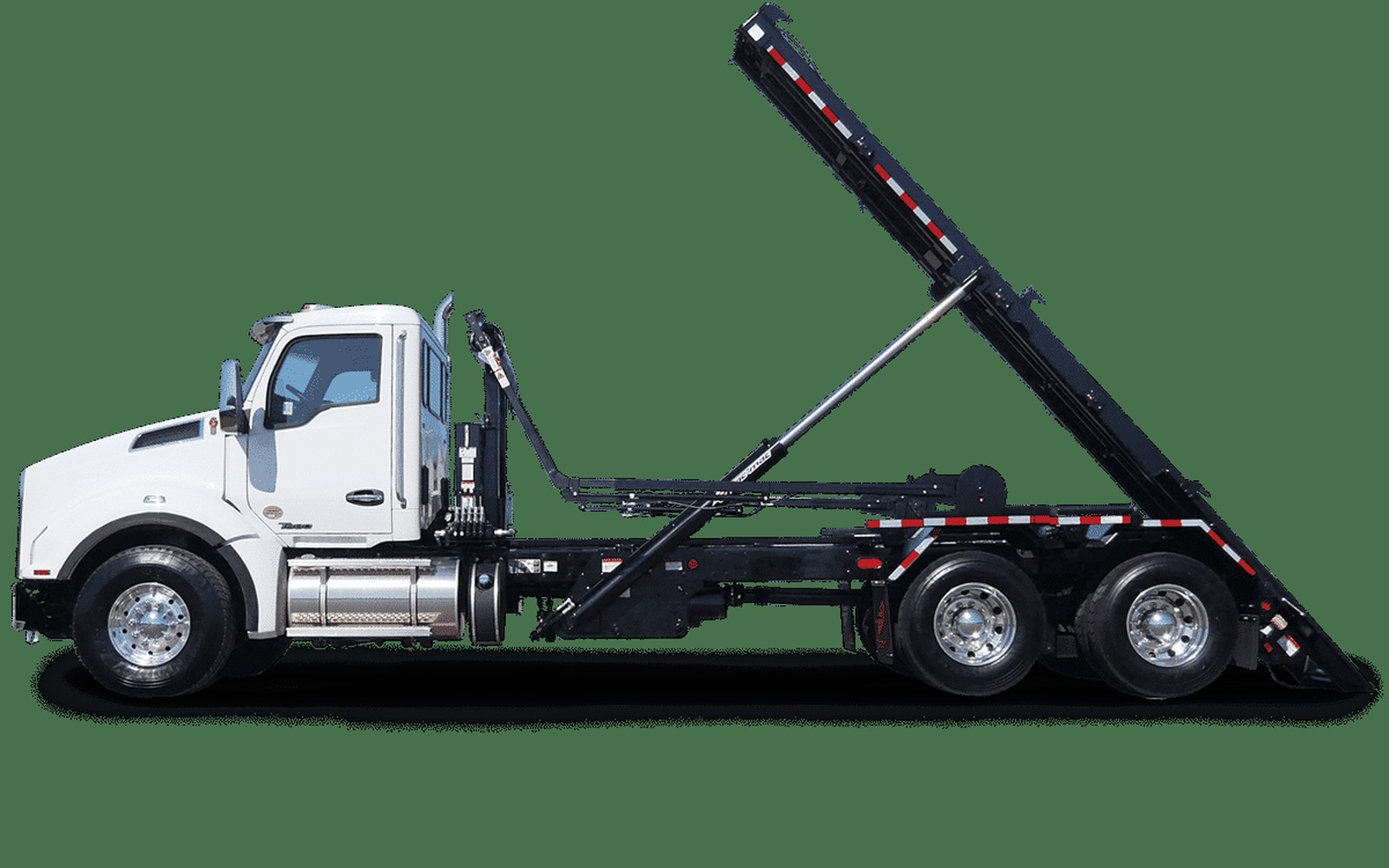
Urban routes do not forgive a truck that cannot turn. The cabover configuration puts the cab directly above the front axle, which shortens overall vehicle length by several feet compared to a conventional hood design on the same chassis rating. For roll-off operators who work narrow downtown alleys, dense urban neighborhoods, or properties with tight drive access, that difference in turning radius is the whole operational equation. We finance cabover roll-off trucks for operators who need to service the accounts that a conventional long-nose rig cannot reach.
Cabover roll-off trucks are not as widely available as conventional configurations, which means the used market is thinner and lead times on new units can be longer. That scarcity dynamic also means that when a good used cabover comes available, operators move quickly, and financing needs to keep pace. We understand the urgency of a narrow-window used-unit purchase and structure approvals accordingly.
Financing starts at $50,000. Used cabover roll-offs trade in a wide range depending on age, chassis condition, and hoist spec, often from $60,000 to $130,000 for production-ready units. New cabovers on current chassis run $200,000 or higher for a fully upfitted configuration. Application-only approval runs to approximately $400,000. B and C credit borrowers are welcome. Standard timeline is one to two weeks to funding.
Cabover Design and Operational Advantages
A cabover engine (COE) truck positions the cab forward over the engine rather than behind it. The resulting shorter wheelbase and reduced overall length (often 10 to 15 feet shorter than a comparable conventional truck) allows tighter turning and maneuverability in constrained environments. For urban roll-off operations, this configuration opens accounts that are physically inaccessible to standard Class 8 roll-off rigs.
Freightliner's EconicSD is a notable example of a cabover chassis gaining traction in North American refuse applications. European waste collection has long relied on cabover designs for exactly the urban maneuverability reasons that are now relevant in dense American metro markets. The Battle Motors LNT, which also uses a cab-forward layout, offers similar benefits. Both are designed with driver visibility in mind, which is an important safety consideration in tight urban environments with pedestrians and cyclists.
The hoist mounted on a cabover chassis operates essentially the same way as on a conventional truck. The container pickup and drop sequence is not meaningfully different. The tradeoff is that the shorter frame constrains the maximum container length the truck can carry. A standard cabover roll-off configuration is typically suited to 20-yard and some 30-yard containers rather than 40-yard open-tops, which require a longer frame. Operators whose accounts predominantly use 20- and 30-yard containers lose nothing operationally by switching to a cabover.
For operators evaluating a cabover against a conventional roll-off truck, the decision usually comes down to the account mix. Urban-heavy operators with a significant percentage of downtown commercial and restaurant dumpster accounts often find the cabover earns back its premium through access to accounts the conventional rig cannot service.
Where Cabovers Win Routes
Dense coastal metros, older Northeastern and Midwestern cities, and historic downtown districts are where cabover roll-off trucks consistently outperform conventional configurations. In markets like New York, Boston, Philadelphia, and Chicago, many commercial properties have rear-alley dumpster access that simply does not accommodate a 40-foot conventional roll-off rig making a turn. The operator who can service those addresses with a cabover holds an account the conventional-fleet competitor cannot.
Operators serving commercial waste collection accounts in dense urban cores find the cabover particularly valuable for restaurant row, hotel, and retail accounts where back-of-house access is constrained. These are often the most lucrative recurring accounts in a commercial waste operation because the volume is predictable and the contracts renew without much price pressure when service is reliable.
Restaurant districts and entertainment zones also generate significant junk removal and one-time container demand. Operators who can drop a 20-yard container in a tight urban alley for a restaurant cleanout or a retail renovation build account relationships that generate recurring referrals.
Qualifying for Cabover Roll-Off Financing
Qualification follows the same criteria as any roll-off financing. We look at the credit file, three months of business bank statements, and the unit's condition and value. Application-only approval handles most deals up to $400,000 without requiring tax returns.
For operators with established urban commercial accounts, the bank statements typically show consistent weekly revenue from container pickups, which supports the serviceability analysis. Operators who are newer to the business or who are adding a cabover to target a new urban market segment may need additional documentation demonstrating the account pipeline or a contract commitment.
Bad-credit borrowers considering a cabover purchase should know that the thinner used-market for cabovers can complicate underwriting slightly because there are fewer comparable sales to establish collateral value. Providing a dealer invoice or an independent appraisal helps anchor the deal. Our bad-credit truck financing program handles borrowers with imperfect credit histories who have the route revenue to support the payment.
For operators buying a new cabover, the refuse truck loan structure with a fixed rate over 60 months is often the simplest and cleanest path. Lease structures are also available for operators who prefer the tax treatment or the flexibility to upgrade chassis at the end of the term. Operators entering the market for the first time should also review our startup financing program and the application-only financing track, which keeps documentation requirements manageable for deals up to approximately $400,000.
Route Questions